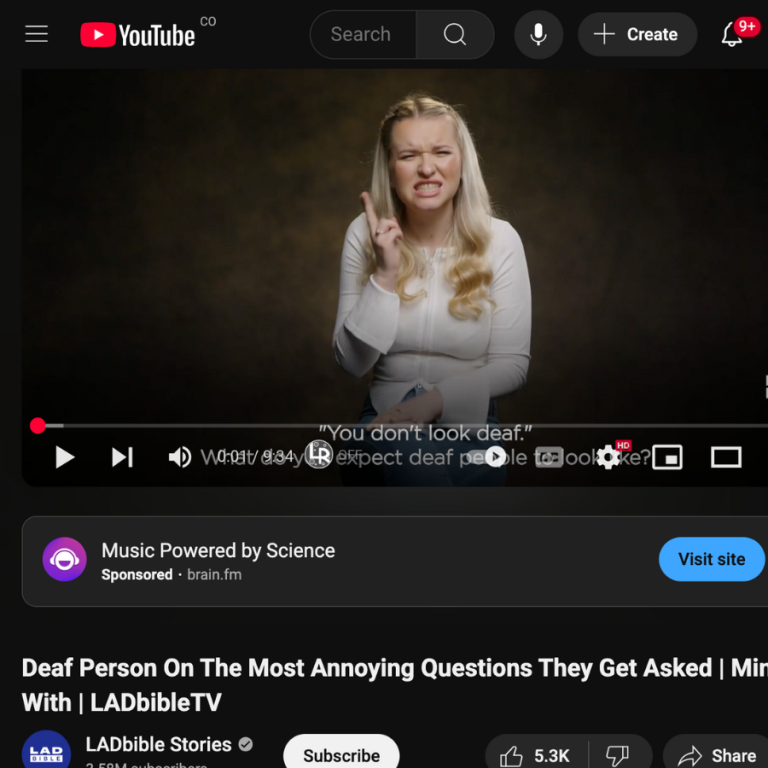
Deaf Person On The Most Annoying Questions They Get Asked | YouTube – LADbibleTV
Jazzy talks about the most annoying questions people ask her about being deaf, what dating is like in the deaf community and how she experiences music.
Through Deaf Eyes explores almost 200 years of Deaf life in America and presents a broad range of perspectives on what it means to be deaf. The film is propelled by the stories of people, both eminent and ordinary, and sheds light on events that have shaped Deaf lives.
What if your first encounter with a deaf person is not met with the same excitement that you were hoping for? There are many reasons that the encounter might not go the way that you think. It’s easy to get discouraged but don’t be! We share our perspective and explain why this is OK and you should keep trying to communicate with deaf people.
American Sign Language, known widely as ASL is something that people are used to seeing. Though everyone doesn’t speak the language, we as a society understand the important role it plays in the lives of those who are or know someone who is deaf or hard of hearing. Classes are offered online, at local libraries, and even at universities because ASL is a full language on its own with its own set of rules. Given the wide acceptance and understanding of the need for ASL, it’s hard to believe that it was once banned in America.
Yes, banned. In the early years of ASL, it was a developing tool for deaf people to communicate with each other and those around them. The language was developed using the natural human inclination to use hand gestures to communicate. It quickly caught on and became a cohesive language which resulted in it being taught to deaf children in schools. “There are more than 150 different sign languages used around the world that are distinct from each other and the spoken languages in the same places,” Erica Brozovsky, Ph.D. says on an episode of PBS’ Otherwords, of which is she is the host and writer.
A school for the deaf was established in 1816 after French educators and American advocates opened The American School for the Deaf. This school allowed deaf students from different parts of America to receive an education in a place where the kids could learn using signs and gestures instead of speech. The French educators brought French sign language which American students combined with the gestures they used at home to communicate with their family. It helped deaf Americans build community and solidify ASL as a standard language for deaf people in the United States.
The filmmakers and participants of “Deaf President Now!” talks to Los Angeles Times editor Matt Brennan about the film, deaf issues and how they are working to make lives better for their community while at the L.A. Times Studios @ Sundance Film Festival presented by Chase Sapphire Reserve.
From Academy Award-nominated producer, co-director and Deaf activist Nyle DiMarco, and Academy Award-winning producer and co-director Davis Guggenheim, “Deaf President Now!” recounts the eight days of historic protests held at Gallaudet University in 1988 after the school’s board of trustees appointed a hearing president over several very qualified Deaf candidates. After a week of rallies, boycotts and protests, the students of Gallaudet University triumph as the hearing president resigns and beloved dean Dr. I. King Jordan becomes the university’s first Deaf president.
Experience the world of American Sign Language and fully immerse yourself in Deaf culture while enjoying the natural beauty of Aspen Camp’s 17 acres along Snowmass Creek.
This program is designed for ASL students, interpreting students, parents, caregivers, family members, public school employees, interpreters, or any adult who wishes to enhance their receptive and expressive ASL skills. It is exclusively for adults aged 18 and older.
ASL 1 Immersion Camp (July 18–21, 2025) – For those who are new to ASL and Deaf culture or at a beginner level.
ASL 2 Immersion Camp (July 25–28, 2025) – For those who have already taken ASL lessons and can engage in basic ASL conversations.
ASL For the first three decades of television, there were no captions of any kind, leaving Deaf viewers unable to fully participate in a medium that shaped culture and conversation. The fight for closed captioning was a battle for access and inclusion. Deaf advocates spent decades pushing broadcasters, lawmakers, and technology companies to make television—and later, the internet—accessible.
RSO Spotlight: American Sign Language Club immerses students in ASL and Deaf culture | Western Herald
The American Sign Language (ASL) Club at Western Michigan University is a registered student organization (RSO) dedicated to providing a space on campus where students can practice using ASL. The RSO also strives to promote ASL and Deaf culture, giving a social outlet to members of the Deaf community.
“Joining the ASL Club is a fun opportunity to immerse yourself in sign language,” said member Ray Dukes.
They continued: “Maybe you’re learning ASL for yourself, for a family member or for fun; either way, it’s good practice and a nice community to be a part of.”
Dukes is a senior at WMU and has always been passionate about ASL. In high school, they taught themself how to sign through YouTube videos. When they began studying at WMU, they were able to start taking ASL classes and engage with Deaf culture through the ASL Club.
“My favorite part is the community,” Dukes said. “It’s people who love the culture and are actually interested in learning the language.”
The Deaflympics is a “culturally important event” in the calendar but athletes have to fund themselves, says the CEO of UK Deaf Sport.
Chris Ratcliffe, 57, was born profoundly deaf and has represented Great Britain at the Deaflympics as a swimmer, as well as winning the Deaf Rugby World Cup in 2002 with Wales.
The Deaflympics, inspired by the Olympics, was set up partly to celebrate deaf culture, but also “to be able to compete with one another on a level playing field,” Mr Ratcliffe said.
He is hoping to raise awareness of the Deaflympics as it celebrates its 100th anniversary.
What is the Deaflympics?
The first Deaflympics was held in Paris back in 1924, with nine countries including Great Britain taking part.
It takes place every four years, with the 51st games to be held in Tokyo next year.
UK Deaf Sport is hoping to send a team of 115 people in sports such as athletics, swimming, and football.
This site uses cookies. By continuing to browse the site, you are agreeing to our use of cookies.
OKLearn moreWe may request cookies to be set on your device. We use cookies to let us know when you visit our websites, how you interact with us, to enrich your user experience, and to customize your relationship with our website.
Click on the different category headings to find out more. You can also change some of your preferences. Note that blocking some types of cookies may impact your experience on our websites and the services we are able to offer.
These cookies are strictly necessary to provide you with services available through our website and to use some of its features.
Because these cookies are strictly necessary to deliver the website, refusing them will have impact how our site functions. You always can block or delete cookies by changing your browser settings and force blocking all cookies on this website. But this will always prompt you to accept/refuse cookies when revisiting our site.
We fully respect if you want to refuse cookies but to avoid asking you again and again kindly allow us to store a cookie for that. You are free to opt out any time or opt in for other cookies to get a better experience. If you refuse cookies we will remove all set cookies in our domain.
We provide you with a list of stored cookies on your computer in our domain so you can check what we stored. Due to security reasons we are not able to show or modify cookies from other domains. You can check these in your browser security settings.
These cookies collect information that is used either in aggregate form to help us understand how our website is being used or how effective our marketing campaigns are, or to help us customize our website and application for you in order to enhance your experience.
If you do not want that we track your visit to our site you can disable tracking in your browser here:
We also use different external services like Google Webfonts, Google Maps, and external Video providers. Since these providers may collect personal data like your IP address we allow you to block them here. Please be aware that this might heavily reduce the functionality and appearance of our site. Changes will take effect once you reload the page.
Google Webfont Settings:
Google Map Settings:
Google reCaptcha Settings:
Vimeo and Youtube video embeds:
The following cookies are also needed - You can choose if you want to allow them:
You can read about our cookies and privacy settings in detail on our Privacy Policy Page.
Privacy Policy